Mary Sidney and George Herbert
Multitude of Voyces is based in Salisbury, Wiltshire, UK, where there are close historical links to the writers Lady Mary Sidney (1561-1621) and George Herbert (1593-1633). While Herbert’s poetry and influence are widely known and celebrated and there are societies dedicated to his work, the work of his great-aunt through marriage, Lady Mary, is little-known outside of academic circles.
Our Sidney and Herbert Project draws the two family members together through thematically-related texts; Sidney’s translation/paraphrase of verses from Psalm 63, O God, the God where all my forces ly, set by Esther Bersweden, and Herbert’s poem Even-song set by Judith Ward with a complementary set of Preces and Responses. J
Project in development - Autumn 2026
Mary Sidney (1561-1621)
Lady Mary Sidney:
Mary Sidney was an astute and influential figure, who had close connections with Wilton in Wiltshire (England) through her marriage to the immensely powerful Henry Herbert, 2nd Earl of Pembroke. Family members, and acquaintances of Sidney’s extended family (including the poet John Donne who was Herbert’s godfather), became known as the ‘Wilton Circle’, and were highly influential and pioneering in the arts. Sidney lived in Wilton House, a very substantial home built on the ruins of Wilton Abbey - a Benedictine abbey founded around the ninth century for the daughters of the aristocracy - within living memory of Wilton’s Abbey’s dissolution by Henry VIII in 1539. With the dissolution of the Abbey the influence of powerful female figures dwindled as the patriarchal institution of Salisbury Cathedral (where Sidney was later buried) became the dominant influence locally.
Crucially, as a member of an aristocratic family she had enjoyed a very high level of education in comparison with most girls and women of her time, though it was not equal to that of her male peers, and the pathways open to her as a creative adult were limited due to societal expectations of women.
As a married woman moving in Court circles, she adroitly navigated complex religious and political territory. As a writer of devotional lyric poetry she developed her own particular style which was to influence the next generation of poets.
Following the death of her brother, the poet, soldier and artistic patron Philip Sidney, in 1586, the bereaved Mary broke new ground by creating her own translations/paraphrasing of Psalms to complete a project begun by him. Her texts were published (through handwritten copies) and circulated to a limited degree in her lifetime. However, her influence faded and it was not until the 1820s that her work was re-published (in a limited edition of 250 copies) followed nearly a century later by a biography.
Project in development - Autumn 2026
L Stewart for MoV (c)MoV 2026
George Herbert (1593-1633)
George Herbert was born in Montgomeryshire in Wales - by then united legally with England - where his father was a Member of Parliament and a Sheriff. Herbert was a great-nephew of Mary Sidney through her marriage to Henry Herbert (2nd Earl of Pembroke) and was also wealthy and privileged, though to a lesser degree than the Earl and the Countess. He was able to access a university education - something not open to women at the time, and like his great-aunt he moved freely and confidently in the circles of some of the most-influential poets and philosophers of his time, including those of the Wilton Circle.
Herbert was ordained in the latter part of his life and his final post was in Wiltshire (England), as the priest of the parish of Fugglestone-cum-Bemerton (whose patron was the Earl of Pembroke), the churches of St Peter’s in Fugglestone and St Andrew’s in Bemerton being each just a mile or two away from Wilton and from Salisbury. In the three years between his arrival in Bemerton and his untimely death in 1633 from tuberculosis, Herbert earned a warm reputation as a committed pastor. He enjoyed regular artistic and musical contact with the canons and the community at his mother-church of Salisbury Cathedral and those connections between Herbert and the Cathedral remain to this day, though Herbert himself had a modest burial not in the Cathedral but in his own tiny church of St Andrew’s Bemerton, just a few footsteps away from his vicarage.Project in development - Autumn 2026
Even-song
Preces, Responses and The Lord's Prayer
Judith Ward is a composer, church musician and teacher based in Oxfordshire. Her choral music has been broadcast on Radio 3 and performed in the UK, Europe and America. Her work has been described as “inspiring and accessible”, “very effective” and “refreshingly original”. Esther Bersweden is a British composer whose interest lies in making new music accessible, meaningful and enjoyable for performers and audiences alike.
Judith’s Preces and Responses on Even-song were premiered by Imperial College Chamber Choir, directed by Patrick Allies, on Wednesday 13th May 2026 at All Saints Church, South Kensington and recorded by Continuum Choral Foundation.
Project in development - Autumn 2026
O God, the God where all my forces ly
Esther Bersweden is a British composer whose interest lies in making new music accessible, enjoyable and meaningful for performers and audiences, and whose passion is centred around writing and directing choral music. Her works have been widely performed by UK parish and cathedral choirs, broadcast on Radio 3 and BBC1, and commissioned by choirs such as St Martin’s Voices, Bristol Bach Choir, St Mary Redcliffe, Redland Green Choir, Eltham Choral Society, St Mary’s Wimbledon, Thames Chamber Choir and City of Bristol Choir.
Esther's anthem O God, the God where all my forces ly was premiered in concert by Choir of Peterhouse, directed by Dr Simon Jackson on Saturday 7th March 2026 at St Peter’s Church, Oundle, in celebration of International Women’s Day.
Project in development - Autumn 2026
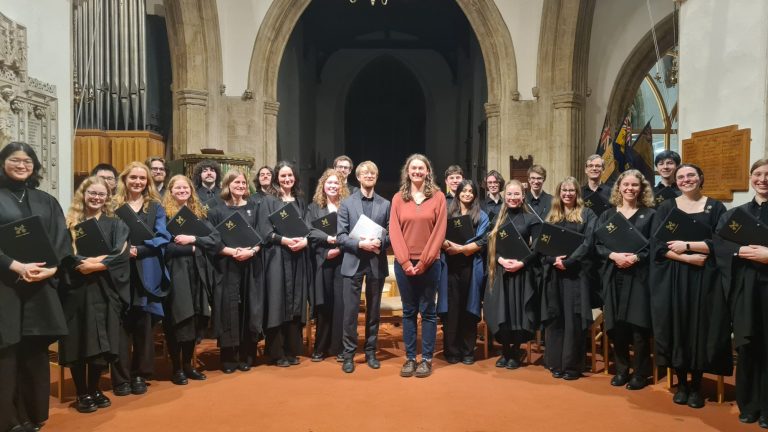
Choir of Peterhouse, Cambridge, their director, Dr Simon Jackson and composer Esther Bersweden at St Peter's Church, Oundle. Photo: Josh Hutchinson
Reflection
While Sidney and Herbert’s texts reflect their personal devotion and piety, it is a fact that they and their families moved in circles whose political, religious and financial actions beyond England and Wales had lasting impact and ramifications for entire communities whom Sidney and Herbert would never themselves meet. In particular, Herbert’s connections with his step-father and wife’s family, the Danvers, and his friend (and posthumous publisher), Nicholas Ferrar, warrant further reading for a wider context. We recommend exploring the work of Professor Philip Jenkins of Baylor University; the full text of an essay which illuminates some connections between the Pembroke, Danvers and Ferrar families and their associations with the Virginia Company, is available from MoV on request.
Recommended reading:
- Mary Sidney Herbert Countess of Pembroke, by Julia Allen and Christine Bennett
- The English Poems of George Herbert, edited by Helen Wilcox
- George Herbert and Early Modern Musical Culture, by Simon Jackson
- Philip’s Phoenix, by Margaret P. Hannay
- Music at Midnight, by John Drury
Project in development - Autumn 2026